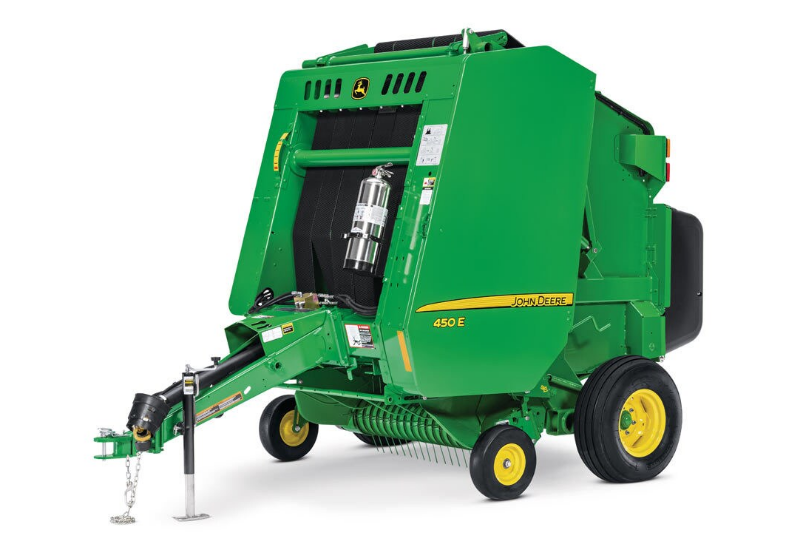
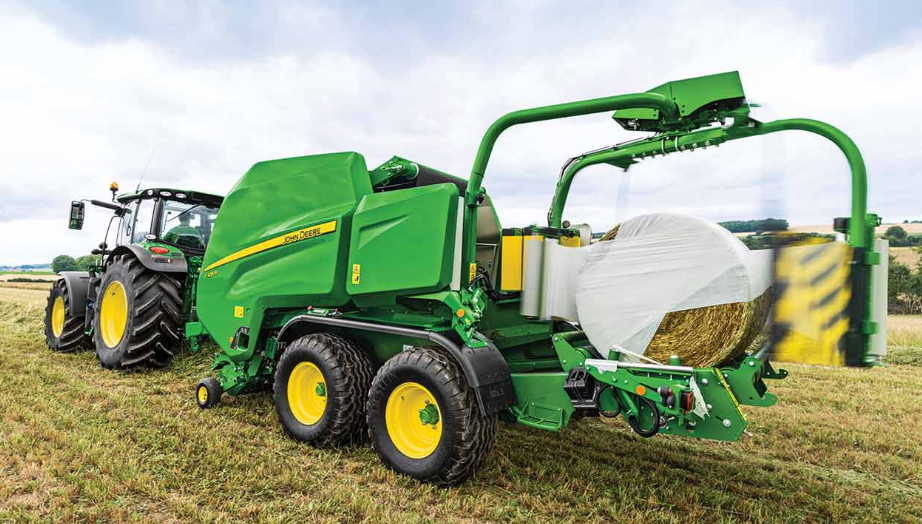
Mounted in front of the baler wheels and directly below the bale chamber, the pickup hugs the ground for clean crop retrieval. Hay movement is minimized.
V-belt driven
450E and 450M Baler pickups are 116.6 cm (45.9 in.) wide
Large reel shaft and reel bearing
The small-diameter, low-profile pickup allows for good ground gauging and clean crop retrieval.
Handles large, heavy windrows of hay and high-moisture crops
Feeds hay directly to the forming chamber to reduce crop loss
Low-profile pickup minimizes hay lift to reduce chaffing and retain hay quality
Side flares prevent hay from blowing off the pickup ends, which reduces hay loss.
The closely-spaced pickup teeth extend to the baler side sheets to help build straight-edged bales.
Standard on regular pickups, compressor rods are contoured to control hay over the pickup radius for positive feeding. The compressor rack can be adjusted upward or downward to match the volume of material in the windrow and can be easily removed to match crop conditions.
Adjustable crank handle
The adjusting crank positions the pickup to the desired operating height to match crop or field conditions.
An optional hydraulic pickup lift cylinder is available as an attachment.
Makes raising for transport or clearing obstructions easy
Crank handle serves as a down stop
Adapts to regular and MegaWide™ Plus pickups
Hydraulic pickup lift comes standard on premium machines
John Deere’s 178-mm (7-in.) wide diamond-tread design ensures fast bale starts and grips the bale to prevent slippage and reduce chaffing. The treads are self-cleaning to reduce carryover. The belts are staggered to reduce the loss of fine material and are closely spaced to contain the hay for fast, easy starts.
The belts enclose 91 percent of the bale width to reduce loss of fine material and retain hay quality.
The staggered belt roll design enables any loose hay under or behind the belts to be returned to the pickup and into the baler. This design helps to prevent buildup at the front of the baler, which could cause hay loss and belt or splice damage.